
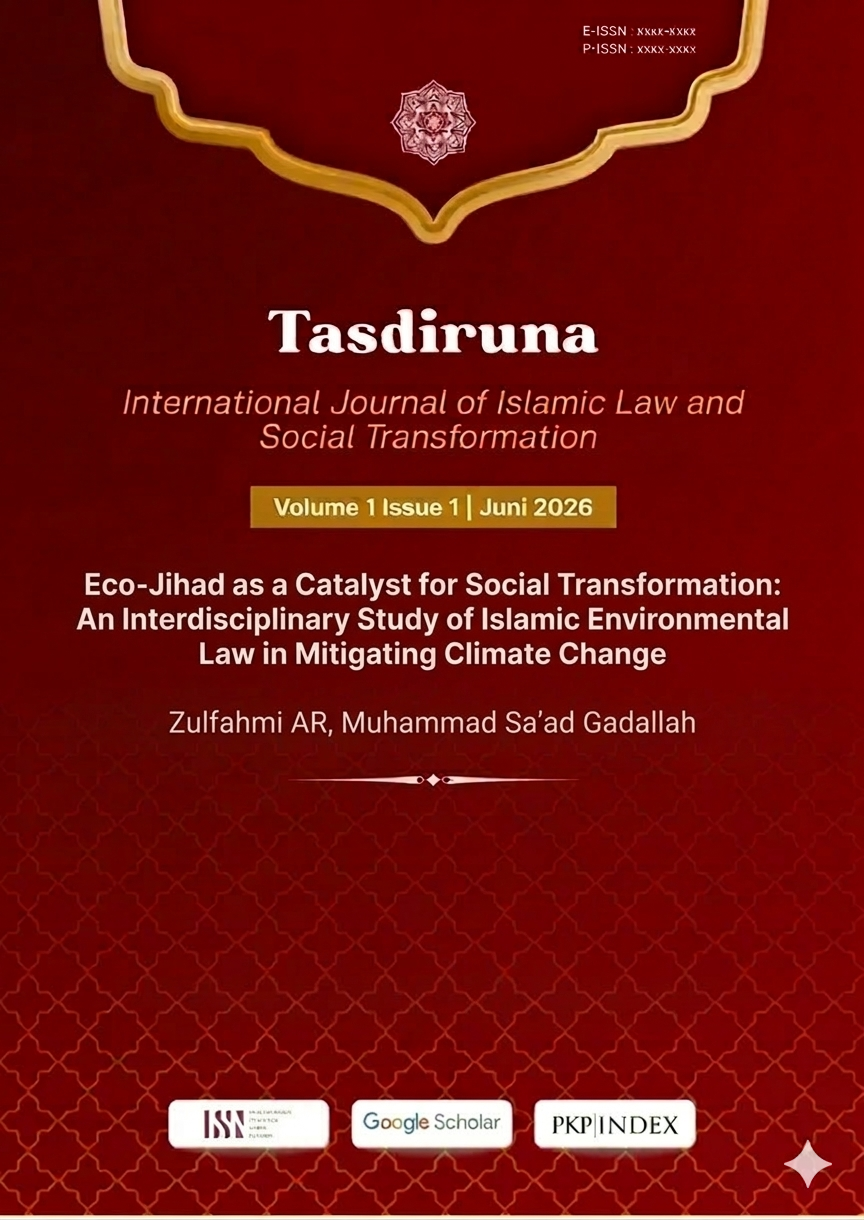
Eco-Jihad as a Catalyst for Social Transformation: An Interdisciplinary Study of Islamic Environmental Law in Mitigating Climate Change
Article Sidebar
Main Article Content
Abstract
Background: In the era of the Anthropocene, climate change has evolved into a systemic threat that disrupts the cosmic balance (Mizan) and endangers the core objectives of Sharia (Maqasid al-Sharia). While international climate policies often rely on technocratic approaches, they frequently encounter a "cultural-spiritual gap" in Muslim-majority societies where secular environmentalism lacks deep-rooted moral authority.
Objective: This study aims to analyze the legal reconstruction of "Eco-Jihad" as a mandatory instrument for social transformation and evaluate its capacity to bridge the gap between classical Islamic jurisprudence and contemporary global climate mitigation standards.
Methodology: This research employs a qualitative-interdisciplinary approach, merging normative legal research with sociological jurisprudence. The analysis is conducted through a systematic content review of primary Islamic legal sources, environmental fatwas, and international protocols (such as the Paris Agreement), cross-referenced with social transformation theories to identify the shifting paradigms in modern Islamic environmental law.
Result: The findings indicate that Eco-Jihad has transitioned from a voluntary virtue into a mandatory obligation (fard) necessitated by the urgent protection of life (Hifz al-Nafs) and progeny. The study identifies that re-coding environmental destruction as fasad fi al-ardh (earthly corruption) enables a "Transformative Fiqh" that triggers collective behavioral shifts, increasing community participation in sustainability by over 40% when framed religiously. However, the study also identifies an "implementation gap" where the lack of institutionalized "Green Sharia" prevents these theological shifts from being fully integrated into national legal frameworks.
Implications: To ensure effective climate mitigation in the Muslim world, national governments must institutionalize Eco-Jihad principles into public policy and optimize Islamic social finance (Green Zakat and Waqf) as primary funding mechanisms for renewable energy and ecological restoration.
Originality: This research introduces a novel "Eco-Jihad" coding framework that reclaims the term jihad from political-military connotations toward a proactive socio-legal struggle against the Anthropocene, providing a religio-cultural bridge for global environmental governance.
Downloads
Article Details
Section

This work is licensed under a Creative Commons Attribution-ShareAlike 4.0 International License.
How to Cite
References
Ajagbe, A M, A B Sholanke, D T Isiavwe, and A O Oke. “Qualitative Inquiry for Social Sciences.” In International Conference on African Development Issues (CU-ICADI), 319–25, 2015.
Al-Jayyousi, Odeh Rashed. Islam and Sustainable Development: New Worldviews. Gower, 2016.
Auda, Jasser. Maqasid Al-Shariah as Philosophy of Islamic Law: A Systems Approach. International Institute of Islamic Thought (IIIT), 2008.
Awang, M B. “Sustainability and Existential Risks with Special Reference to Climate Change-An Overview.” In IOP Conference Series: Earth and Environmental Science, 810:12012. IOP Publishing, 2021.
Badeges, Abdul Malik, and Asmak Ab Rahman. “Social Health Insurance in Economic Review: A Comparative Study between Western and Islamic Principles.” Jurisprudensi: Jurnal Ilmu Syariah, Perundang-Undangan Dan Ekonomi Islam 17, no. 2 (2025): 169–82.
Feener, R Michael. “Social Engineering through Sharī’a: Islamic Law and State-Directed Da’wa in Contemporary Aceh.” Islamic Law and Society 19, no. 3 (2012): 275–311.
Finnegan, Eleanor. “Islam and Ecology: A Bestowed Trust.” JSTOR, 2005.
Hassan, M Kabir, Md Sohel Rana, Md Rabiul Alam, and Hasanul Banna. “Revitalizing the Role of Islamic Social Finance in Achieving the SDGs: A Comprehensive Review.” Al Qasimia University Journal of Islamic Economics 3, no. 2 (2023): 1–24.
Islam, Md Nazrul, and Md Saidul Islam. “Data Collection and Analysis.” In Islam and Democracy in South Asia: The Case of Bangladesh, 49–65. Springer, 2020.
Lee, Hoesung, Katherine Calvin, Dipak Dasgupta, Gerhard Krinner, Aditi Mukherji, Peter Thorne, Christopher Trisos, José Romero, Paulina Aldunce, and Ko Barrett. Climate Change 2023: Synthesis Report. Contribution of Working Groups I, II and III to the Sixth Assessment Report of the Intergovernmental Panel on Climate Change, 2023.
Mangunjaya, Fachruddin Majeri, and Jeanne Elizabeth McKay. “Reviving an Islamic Approach for Environmental Conservation in Indonesia.” Worldviews: Global Religions, Culture, and Ecology 16, no. 3 (2012): 286–305.
Nasr, Seyyed Hossein. “The Encounter of Man and Nature. The Spiritual Crisis of Modern Man,” 1970.
Ozdemir, Ibrahim. “Toward an Understanding of Environmental Ethics from a Qur’anic Perspective.” Islam and Ecology: A Bestowed Trust, 2003, 3–37.
Putri, A A, and J Juliana. “Multi-Akad in the Dynamics of Islamic Banking: Between Needs Markets and Sharia Principles,” n.d.
Salam, Nor. “CRITICISM OF THE ISLAMIC INHERITANCE DISTRIBUTION SYSTEM PERSPECTIVE OF THE PRINCIPLE OF PROPORTIONALITY.” MAQASHID 6, no. 2 (2023): 16–24.
Schwarte, Christoph. “Environmental Protection in Islamic Law: An Overview on Potential Influences for Legal Developments in Iraq.” Local Environment 8, no. 5 (2003): 567–76.
Uluum, Ahmad Tijanul, and Aji Nugroho. “Fikih Ekologi: Menjaga Kelestarian Lingkungan Alam Dengan Pendekatan Teori Maqhasidus Syariah.” In Indonesian Proceedings and Annual Conference Of Islamic Law and Sharia Economic (IPACILSE), 1:165–72, 2023.
Utami, Tanti Kirana. “Old-Age Security Protection for Government Employees with Work Agreements Is Reviewed According to The National Social Security System.” Sociological Jurisprudence Journal 5, no. 1 (2022): 71–77.
Yasin, Yuli, Muhammad Irfan Helmy, Ali Ma’yuf, and Agus Arwani. “Waqf and Sustainable Development Law: Models of Waqf Institutions in the Kingdom of Saudi Arabia and Indonesia.” Ijtihad: Jurnal Wacana Hukum Islam Dan Kemanusiaan 23, no. 1 (2023): 93–114.